
Burnout Therapy for High Achievers
Therapy for burnout with clinical psychologists, for people who can't just walk away from the life they built
Online burnout therapy in California, Texas, Virginia, and 40+ PSYPACT states | A Los Angeles-based psychology practice












Does This Sound Like You?
You know you feel depleted, and you can't explain why.
From the outside, you look like someone who has it made. You have the title, the practice, the firm, the exit, the household that runs without you having to think about it. On paper, you should be satisfied. But inside, you've gone flat.
You still perform. That's the part almost nobody sees. You show up, you deliver, the referrals keep coming, but privately you're running on fumes and grim momentum. The people closest to you have noticed. Your partner says you're here, but not really here. Yes, you're physically present at dinner, but some part of you is still in the OR, in the board deck, in the deposition.
Some of what you might recognize:
You either can't fall asleep, or you sleep and wake up just as tired.
Your mind runs the day back on a loop, scanning for all the things you missed.
You've started to dread emails that you used to answer in thirty seconds.
Everything takes more out of you than it used to, and you've stopped expecting that to change.
Some days, you wonder what all of this was even for because existential dread has set in.
Underneath it all, there's a question that you've barely let yourself say out loud: if I built exactly the life I've always wanted, then why do I still feel trapped?
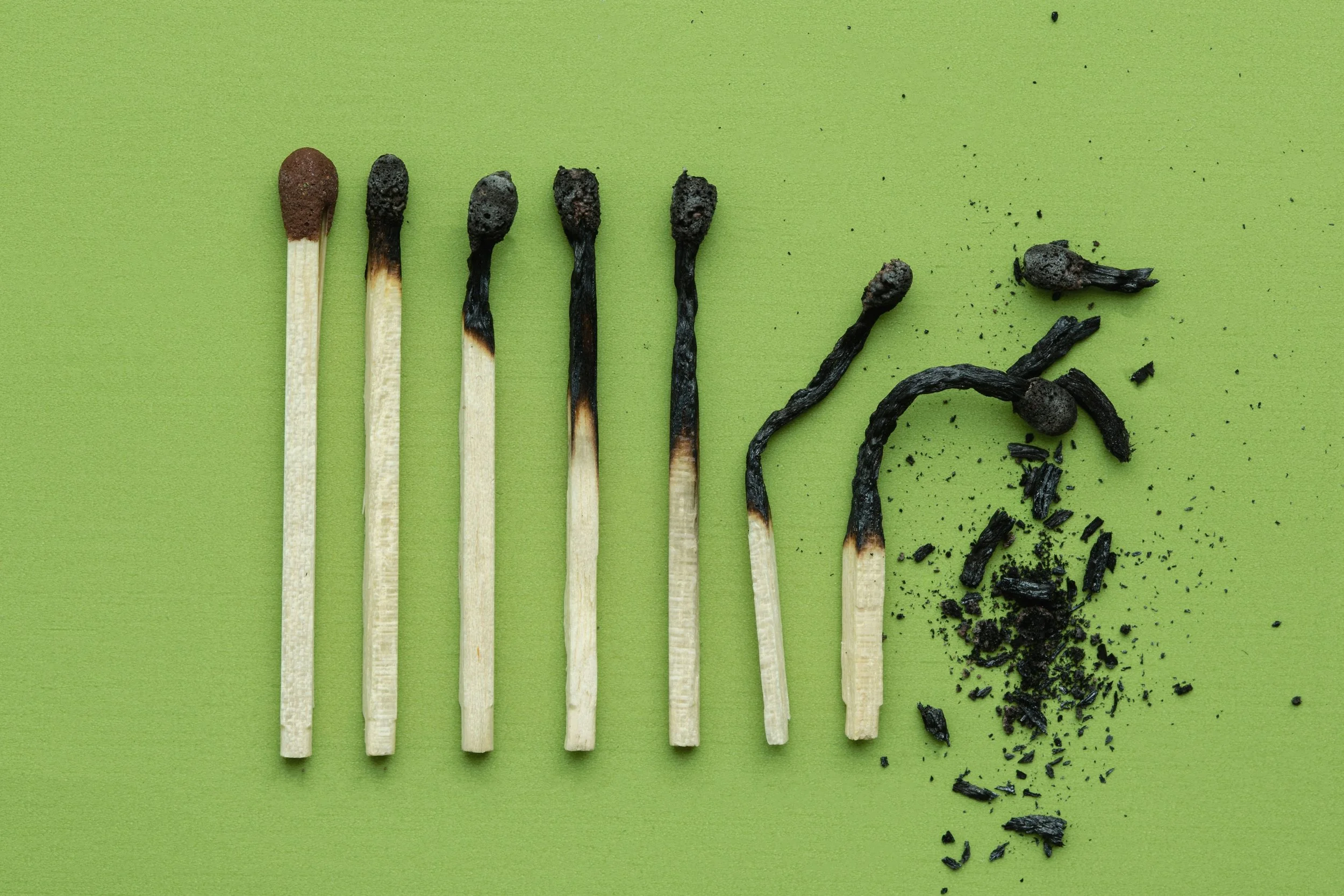


Can I Recover from Burnout Without Quitting My Job?
Usually, yes. Most of the people we work with recover while continuing to practice, lead, litigate, or run their companies. We address this early and plainly, because it's often the question that prevents people from reaching out at all.
There's a version of burnout advice that says the only real fix is to leave: quit, take a sabbatical, restructure your entire life. For a small number of people in genuinely unsafe work situations, that may be the right clinical answer, and we'll say so directly if it's what we see. But for most of our clients, it isn't, and quitting was never realistic anyway. You have partners, patients, payroll, a name on the door. A whole life you've built.
We also want to be clear about something that gets glossed over constantly in writing about burnout. Some workloads are objectively inhumane. A panel of a thousand patients, a call schedule with no room for recovery, an institution that keeps adding documentation and calling it efficiency: none of that is reasonable, and no amount of insight makes it reasonable.
Burnout in those conditions isn't a personal failure of resilience or discipline. It's a predictable response to a system built without regard for the people inside it.
What burnout therapy can reach is a different part of the picture: your particular relationship to that load. What the work has been asked to do for you. What makes it nearly impossible to stop, to delegate, to be unavailable for an afternoon. That part travels with you, which is why so many people leave a punishing job, feel better for a few months, only to find themselves in the same conditions somewhere else, sometimes even faster this time.
So, in burnout therapy at Helm Psychology, the work isn't only about your calendar. Yes, we address the concrete load, because there are almost always changes available that you haven't let yourself consider. But the deeper work is understanding what drives the part of you that can't ease off, that can't delegate, that feels a low hum of guilt on Saturdays, that's convinced easing off even a little would mean everything falls apart.
When those deeper dynamics shift, the job usually becomes livable again. And sometimes people do decide to leave, but they leave from a clear place rather than a desperate one.
How Long Does Burnout Recovery Take?
We get asked this in almost every consult call, and we'd rather give you an honest response than a falsely reassuring one.
If nothing about the situation changes, burnout doesn't really resolve on its own. But if you make real changes (including starting therapy), in our experience many people start to notice the acute exhaustion beginning to lift within the first two or three months.
Energy comes back in patches. The fog thins. Sleep tends to improve before mood does.
Recovering more fully while continuing to work usually takes closer to a year, and often longer when the burnout has been building for years, which often surprises people, but we want to say that anyway, because the most common way that burnout recovery fails is this:
Your physiological stress system takes months to settle even after the pressure comes down, so an early lift in energy is real progress, but it's certainly not a finish line.
Burnout recovery also isn't a clean upward line. Yes, there will be a good stretch, then a hard week where one difficult case or a bad meeting knocks you further back than it should. That oversensitivity is a normal phase of the process, and it tends to pass as the work progresses.
Knowing all this in advance is protective, because the people who get discouraged at the first setback are the ones who prematurely abandon the therapeutic work that the burnout actually needs.
What predicts recovery holding isn't how much rest you got. It's whether anything about the conditions, and your relationship to them, actually changed over time.
The most common way burnout recovery fails
- You feel noticeably better.
- You read that as being through it.
- You go back to the same workload and the same internal schemas that produced the burnout problem in the first place.

Is This Burnout, Depression, or Anxiety?
This is worth sorting out early, because the burnout, anxiety, and depression overlap heavily from the inside, and they don't necessarily respond to the same things. Getting it wrong is how people spend a year working on the wrong problem.
Burnout and Depression
Burnout is not a mental health diagnosis and doesn't appear in the DSM-5. The World Health Organization classifies it in the ICD-11 as an occupational phenomenon rather than a medical condition, defined by exhaustion, growing cynicism about your work, and a drop in professional efficacy. Depression is a clinical condition, and it doesn't confine itself to your job.
The rough distinction we listen for: burnout is usually work-shaped. On a real vacation, by day six, something in you comes back online. You can still feel pleasure, it's just that you have nothing left to feel it with.
Depression tends to be everywhere. It follows you onto the vacation, flattens things you used to love that have nothing to do with work, and often carries a heavier layer of worthlessness that's about you as a person, rather than about your job.
In practice, the two frequently coexist, and untreated burnout is a well-established risk factor for depression. Part of what an initial assessment with a clinical psychologist can give you is an accurate read on which of these is actually happening.
Burnout and Anxiety
This distinction matters more for our clients specifically, and it's the one that's most often missed. For a lot of high achievers, the anxiety came first, and the overwork is what manages it. Rechecking the chart, rereading the filing, answering at 11pm, holding a standard nobody else set: these are rarely only symptoms of a demanding job. They're frequently how someone keeps a much older anxiety at a tolerable distance. The strategy works for a while, and it's often what built the career. Then the volume goes up, the strategy stops holding, and the whole thing collapses into exhaustion.
When that's what's happening, rest is frankly going to do very little alone. You can take two weeks off, but you spend the entire time braced. The anxiety needs to be addressed at its source, or the overwork simply resumes, because it's doing a job. This is also why we don't treat burnout as a stress management problem, and why our burnout therapy and our anxiety therapy overlap so much.
Burnout Symptoms, and Why Rest Hasn't Fixed It
Burnout is chronic exhaustion plus cynicism plus a collapsing sense of your own effectiveness, produced by prolonged pressure that never fully lets up.
The symptoms show up in the body as much as the mind: headaches, stomach problems, catching every virus that goes around the office, sleep that doesn't restore, irritability that arrives faster than you can catch it, and a growing detachment from work you used to care about.
But the burnout description most people have already read stops there at the symptom list, and then recommends boundaries and sleep hygiene. If only it were that simple. If that had been enough, you would have solved this already.
The people we work with are unusually competent and highly motivated. They've tried the app, the tracker, the trainer, the two-week break, the productivity system. They've often turned meditation itself into another performance metric.
What tends to be untouched by any of these simplistic coping recommendations are the internal structures underneath: the standards you'd never impose on anyone else, the sense that your self-worth is a scoreboard that resets every morning, the guilt that arrives the moment you aren't producing.
None of that came from your job. Your job just found it and put it to work.

What We Work on in Therapy for Burnout
Burnout is rarely just an exhaustion problem, which is why treating it as one tends not to hold. What comes into focus in the work is usually broader and more personal than the symptom list suggests.
What the exhaustion is expressing
We start with what's most pressing, which is usually that you're running on empty. Early on, that means getting an accurate picture of the load you're carrying, including the things you've lost count of because carrying them feels normal to you now. It also means taking seriously that the exhaustion may be saying something. Sometimes it's the only form of refusal available to someone who has never been able to say no directly.
The ambition that will not switch off
This is often the center of the work. Where these high standards came from, who they were originally for, what they protect you from, and what happens internally when you try to lower them. For many of our clients, achievement became the reliable way to be safe or worth something to someone long before it was a career. That history tends to be sitting inside the burnout.
Ambivalence, shame, and what you can't say out loud
Most people arrive with feelings about their work they've never said to anyone: resentment toward patients or clients they genuinely care about, envy of colleagues who seem to want it less, relief when something gets cancelled, and shame about all of it. Room to say those things without managing anyone else's reaction is frequently the first relief in the process.
Your relationships, and who you are outside your resume
Burnout makes people irritable, withdrawn, and hard to reach, and often the people you love have been absorbing the version of you that has nothing left. Many of our clients can describe their achievements in detail, yet struggle to say what they actually enjoy. The loss of pleasure and purpose isn't a soft concern. It's one of the more reliable signs this has been going on for too long.
The work itself: therapy for work burnout looks at the job, not only at you
We look carefully at your actual job. What can change, what genuinely can't, what you've been told can't change but has never been tested, and how to have the hard conversations that would make a difference. Some of what's making you sick is structural, and pretending otherwise would be its own dishonesty.
Where the drive came from
Most high achievers learned early that being useful was the safest thing to be. In our experience, that history is usually still running the show, and it is the part that most burnout advice never touches. We look at where the drive started, so it stops being the only setting you have.
Our Approach to Burnout Therapy: Depth-Oriented, Not Simplistic “Stress Management”
Helm Psychology is a psychodynamic therapy practice.
That means we're interested in what's underneath the symptoms, not simply in managing them. We aren't going to hand you a worksheet on time blocking.
In practice, this looks like ordinary conversation that over time goes somewhere unexpected. We pay attention to patterns: how you describe your work, what you skip past, what you apologize for, how you treat yourself out loud, and how the two of us relate in the room. Those patterns are the same ones running your relationship to your career, and once they become visible, they become workable.
We also want to be honest about what this isn't. Therapy isn't fast. If there were a quick reliable fix for burnout, our clients would have found it already, because they're the problem solvers, the doers, the fixers.
What you get in therapy at Helm Psychology is therapy that changes the underlying structures, and that does take time.

Two Ways to Work With Us in Burnout Therapy
Burnout therapy does not have to happen in only one format. At Helm Psychology, sessions can happen in different time containers: a steady weekly rhythm, a monthly intensive cadence, or a focused intensive when something needs more room than a standard therapy session can hold.
For some clients, though, a weekly rhythm may not be the right fit, or it may not be enough. This is why, in addition to weekly therapy, we also offer two therapy intensive formats.
Weekly Therapy
This is how we work with most of our clients. Coming consistently, weekly at minimum, or even 2-3 times a week, gives us room to understand and process patterns that keep showing up in your work, relationships, body, ambition, identity, and sense of self. And to stay with them long enough for real growth to unfold.
Monthly Intensive Therapy
Monthly intensive therapy is for clients who want depth and continuity, but need longer sessions less often or whose lives may not fit neatly into a weekly appointment. The work still has continuity, but with more room in each meeting to settle in, follow complexity, and stay with what can sometimes get rushed or flattened in a standard therapy session.
Focused Therapy Intensives
Focused intensives offer concentrated time when something cannot keep being managed around the edges. This could be around a specific pressure point, transition, decision, stuck pattern, or emotional question, or on something harder to name that needs more attention. They are not a shortcut around depth; they are a larger container with more space than a standard therapy session allows.
Why Helm Psychology Is Especially Attuned to Burnout Therapy
Burnout is the most common reason people find us, and nearly all of our clients are high-achieving professionals. That effectively makes this therapy for high achievers, and that matters more than you may think.
You won't spend the first several sessions explaining what a fellowship match is, what partnership track does to a person, or why you can't simply take a month off. We know the terrain, so therapy starts closer to the actual problems.
We are clinical psychologists doing psychodynamic treatment, which puts us in a different category from the burnout coaches, retreats, and wellness programs that dominate this space.
If anxiety or depression is part of what's happening, we can assess and treat it rather than coach around it. And because all our clinicians have extensive experience with physicians, executives, finance & investment professionals, founders, and lawyers, the shapes that burnout takes in those worlds are familiar.
If you want the version of this speaking to your specific world:

Therapy for Physicians




You can also read more on our blog about executive burnout and its hidden drivers, physician burnout treatment and prevention, attorney burnout, and dentist burnout.

Meet Your Burnout Therapists
Annia Raja, PhD
Dr. Raja is a licensed clinical psychologist and the founder of Helm Psychology, practicing in California, Texas, Virginia, and 40+ states.
Before psychology, she worked in management consulting at BCG and in investment banking at Morgan Stanley. She is also married to a physician in a rigorous and demanding specialty.
She knows what these high-stakes worlds ask of people from the inside, not only from across the therapy room, which tends to shorten the amount of explaining her clients have to do.

Chaim Rochester, PhD
Dr. Rochester holds a PhD in Clinical Psychology and is a psychologist handpicked by Dr. Annia Raja.
He came to psychology after a career in corporate consulting and executive coaching, and he works extensively with leaders, high performers, and creatives, including a large share of our burnout referrals.
He also sees clients in the evening, which for a practice like ours is a much-appreciated bonus for clients.

FAQs about Therapy for Burnout
-
Therapy helps with burnout in a way that time off can't, because rest addresses the exhaustion while therapy addresses what produced it. This is why people come back from a real vacation and feel depleted again within weeks. If you've already tried rest and it didn't hold, that tells us something useful about what's actually driving it.
-
No. Almost all of our clients recover from burnout while continuing to work. Occasionally a work situation is genuinely harmful and leaving is the right clinical recommendation, and we'll tell you that directly. Far more often, the job becomes livable again once the internal dynamics driving the overwork shift.
-
In our experience, most people notice the acute exhaustion beginning to lift within the first two or three months of real change, and recovering more fully while still working takes closer to a year, longer when the burnout has been building for years. We'd rather set that expectation honestly than have you think therapy concludes as soon as you feel better.
-
In our clinical experience, burnout tends to build in a recognizable sequence: enthusiasm and overcommitment, then chronic stress you compensate for, then exhaustion with cynicism and detachment, and finally a collapse in your sense of effectiveness. Most people reach out somewhere in the third stage, once compensating has stopped working. Earlier is easier, and later is still very treatable.
-
No, although they overlap and often occur together. Burnout isn't a DSM-5 diagnosis; the WHO classifies it as an occupational phenomenon. Burnout is generally work-shaped and eases somewhat with genuine distance from work, while depression tends to be present across your whole life. An assessment early on clarifies which is actually happening.
-
Cognitive behavioral therapy for burnout can help with the immediate symptoms, and for some people that's enough. Our clients have usually already tried structured, skills-based approaches and found the relief temporary. We work psychodynamically instead, looking at what the overwork is doing for you, which is slower and tends to hold longer.
-
For burnout complicated by anxiety, depression, or years of overwork, a clinical psychologist can assess and treat what's actually happening. Counseling for burnout with any licensed therapist is clinical care. The line worth knowing is between licensed clinicians and burnout coaches, who aren't licensed to assess or treat a clinical condition.
-
A retreat gives you a week away from the conditions, which can feel wonderful and rarely changes anything structural, because you return to the same job with the same internal schemas. We're clinical psychologists doing ongoing depth-oriented treatment, which is slower, less scenic, and considerably more likely to still be working in two years.
-
This is the most common obstacle our clients raise, and it's usually solvable. Everything is online, so no commute is involved. For people whose weeks genuinely can't hold a weekly appointment, therapy intensives of two to four hours are an alternative that fits call schedules and travel far better.
-
Yes. All of our therapy for burnout is online, and we see clients throughout California, Texas, Virginia, plus the 40+ PSYPACT states and DC. You don't need to be in Los Angeles, and most of our clients aren't.
-
No. This is depth-oriented psychodynamic therapy, not a burnout skills curriculum. If tracking something between sessions is genuinely useful for you, we'll do it, but it isn't the substance of the work. You can learn more about our therapeutic approach here.
-
A free 15-minute consult call. You describe what's been happening, we tell you honestly whether we're the right fit and which format makes sense, and you ask whatever you want about how we work. If we aren't the right practice for you, we'll say so and point you somewhere better.
-
No. Helm Psychology is a cash-pay practice. We can provide documentation for out-of-network reimbursement if your plan offers it. You can check our main FAQs page for more info on how that works.
-
Yes. Physicians are one of our largest client groups. Dr. Raja is married to a physician in a demanding specialty, and Dr. Rochester works with physicians across a wide range of specialties. Our physicians page covers medical burnout specifically, including moral injury and the fear of being seen seeking help.
-
Yes, and each has its own page with the specifics: executives and executive burnout treatment, entrepreneurs and founders, lawyers, and finance & investment professionals.
-
Yes, and a substantial share of our clients haven't. Many arrive having decided years ago that therapy was for other people, or that they should be able to handle this themselves. That belief is often part of what we end up working on.
Online Burnout Therapy in California, Texas, Virginia, and 40+ States
All of our work is online. If you've been looking for a burnout therapist in California, Texas, or Virginia, plus any of the 40+ PSYPACT states and DC, we can see you anywhere. For a burned-out professional, telehealth is often the difference between doing this and not doing it: no drive across the city, no waiting room, and instead therapy that can fit between a clinic block and a school pickup, or between a board meeting and dinner.
Let’s Talk
You've been carrying this for a long time, probably longer than you admit. The first step is a 15-minute conversation with an actual psychologist, and it doesn't commit you to anything.
Helm Psychology isn't a crisis service. If you're in immediate danger or thinking about harming yourself, call or text 988 to reach the Suicide and Crisis Lifeline, or call 911.